1. AI we use
The foundation is Google DeepMind's proven models. We do not build a new AI from scratch — we evolve a stable general-purpose AI by combining it with head-restaurant footage to produce a cooking-transfer-specialized model.
- Gemini 2.5 Flash — multimodal LLM. Training core, fine-tuned on 30–50 hours of head-restaurant footage.
- Gemini 3.1 Flash Live — real-time voice dialogue. Learners can ask questions mid-cook and receive spoken answers.
- Gemini Nano — on-device AI running on Galaxy XR or paired smartphone. Sub-100 ms real-time evaluation and function calling.
- YOLOX-S (W8A16) + OSNet x0.25 — object detection + tracker. NPU-accelerated, sub-9 ms inference.
The natural follow-up question is: "Isn't this just fine-tuning on top of a general AI?" The act of fine-tuning is indeed common in the industry. What differs is what comes next — the following section.
2. The dataset is the moat
The real value lies not in one-shot fine-tuning, but in the systematized data-capture system we built specifically to digitize the head-restaurant chef's flavor, and the 5-year time-series accumulation we structurally operate.
- Staged filming guidance tailored to each head restaurant's 30–50 hours of first-person footage.
- Automatic quality scoring of footage (shake, lighting, framing, exposure, etc.).
- 5-year time-series log of changes to the head restaurant's standard — leveraged for automatic evidence generation in disputes.
- Auto-updating 768-dimension Vector DB of head-restaurant embeddings.
A late-arriving competitor would need to independently accumulate the equivalent 5 years of data to build a comparable standard behavior model. Time itself becomes the entry barrier.
3. Korean cuisine 9-axis quantification matrix
We decomposed the elements that influence the head restaurant's signature Korean flavor into nine axes the AI can quantify — fire intensity · broth concentration · fermentation/aging/smoking · seasoning intensity · time alignment · ingredient standardization · seasoning/condiment ratio · ingredient input order · smoke shape. Not every dish uses all nine — per-dish weighting deactivates the fermentation axis for non-fermented dishes, the broth-concentration axis for dishes without broth, and so on.
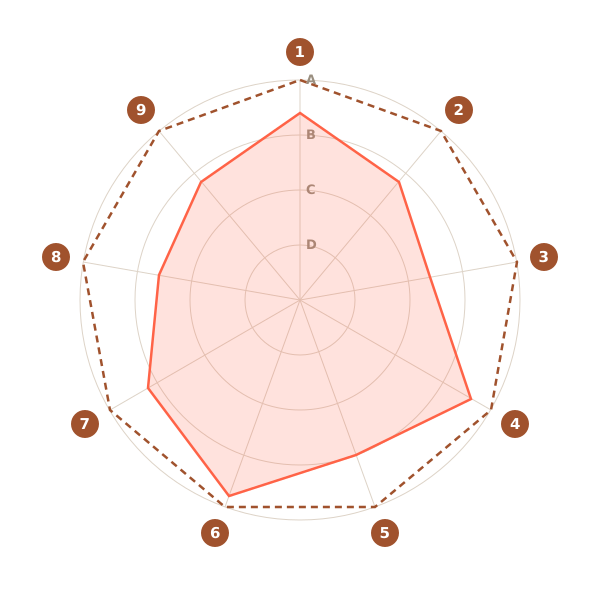
- 1 Fire intensity
- 2 Broth concentration
- 3 Fermentation · aging · smoking
- 4 Seasoning intensity
- 5 Time alignment
- 6 Ingredient standardization
- 7 Seasoning / condiment ratio
- 8 Ingredient input order
- 9 Smoke shape
This 9-axis quantification is one of the principal technical claims in our patent filing. But the patent is not limited to 9 axes.
4. Patent — protecting the full cycle of the field
The patent filed by Cooking Transfer AI (spec docs D5·D6) spans the full cycle of automatically managing franchise-cooking consistency via AI: from the head-restaurant chef's digital standard-behavior model · real-time learner comparison · automatic grade determination · franchisor-operations auto-integration · automatic dispute-evidence generation. It is structured as a multi-claim filing rather than a single narrow claim.
The 9-axis quantification matrix is one dependent claim among many. Other key claims include automatic penalty triggering, franchisor OS auto-integration, 5-year time-series change log, automatic dispute evidence documentation, and device-/OS-agnostic structure. PCT entry to the United States, Japan, China, and EPO within the 12-month priority window is under preparation.
This filing was prepared together with a long-trusted patent attorney. It is not a formal partnership contract, but a relationship trusted enough that a comprehensive power of attorney was recommended.
5. Engineering depth — solid foundations
Designed from day one for real industrial use rather than as a prototype or MVP.
- Explicit module boundaries: app (
:app) · shared contracts (:shared) · backend (:server) · admin web (web/admin). - Interface abstraction: device, LLM, and cloud abstracted behind provider interfaces — adaptable to chipset, model, and platform changes.
- Phase isolation: dependencies between Phase 1/2/3 are kept behind explicit toggles.
- Unit tests + on-device verification: every step verified with unit tests and on real devices (Galaxy XR) before progressing.
6. Riding the AI curve — a complete version within 1–2 years
AI advances rapidly month over month. As each new model ships, we re-fine-tune the accumulated head-restaurant data against the new base. Through this stepwise upgrade path, we expect — within the next 1–2 years — to deliver — in teaching alone — a finished version that surpasses the head-restaurant chef's own ability to transfer their cooking.
The head-restaurant chef is the originator of the cuisine itself, and that mastery is not something AI imitates. Where AI can overtake is the teaching dimension — transferring that mastery consistently to many learners, without fatigue, over time. The current build is around 70% of that complete version — an engineering roadmap, not a present guarantee, and dependent on each restaurant's footage and on validation we have not yet completed.