1. The AI we use
We build on proven models from Google DeepMind. Rather than making a new AI from scratch, we take a stable general-purpose AI, train it on head restaurant footage and turn it into a model built for teaching cooking.
- Gemini 2.5 Flash: a multimodal LLM and the core of training, fine-tuned on 30–50 hours of footage from each head restaurant.
- Gemini 3.1 Flash Live: real-time voice conversation. Learners ask questions out loud while they cook, and the AI answers out loud.
- Gemini Nano: on-device AI that runs on the Galaxy XR or a paired smartphone, for real-time evaluation within 100 ms and function calling.
- YOLOX-S (W8A16) + OSNet x0.25: object detection and tracking, accelerated on the NPU to run in under 9 ms.
It's fair to ask: "Isn't this just your data on top of a general AI?" Fine-tuning on its own is a common technique in the industry. What sets us apart comes next.
2. The dataset is the moat
The real value isn't a single round of fine-tuning. It is the data-capture system we built step by step to digitize a head restaurant chef's cooking, and the way we run it to build up that data over five years.
- A step-by-step filming guide for 30–50 hours of first-person footage at each head restaurant.
- Automatic quality scoring of the footage (shake, lighting, framing, exposure and more, each given a score).
- A five-year record of every change to a head restaurant's standard, used to generate evidence automatically if a dispute arises.
- A vector database of 768-dimension embeddings from head restaurant footage, updated automatically.
A competitor arriving later would have to collect the same five years of data on its own to build an equivalent standard model. Time itself is the barrier to entry.
3. A 9-axis matrix for measuring Korean flavor
We broke down what shapes the flavor of Korean food into nine axes the AI can measure: fire intensity · broth concentration · fermentation, aging and smoking · seasoning intensity · timing · ingredient standards · seasoning and condiment ratio · order of adding ingredients · smoke shape. Not every dish uses all nine. Each dish gets its own weighting, so the fermentation axis is switched off for dishes without fermentation, the broth axis for dishes without broth, and so on.
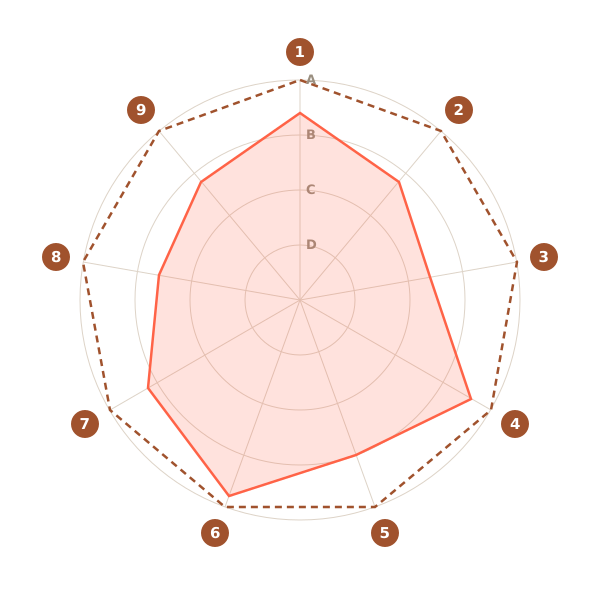
- 1 Fire intensity
- 2 Broth concentration
- 3 Fermentation · aging · smoking
- 4 Seasoning intensity
- 5 Timing
- 6 Ingredient standards
- 7 Seasoning & condiment ratio
- 8 Order of adding ingredients
- 9 Smoke shape
This 9-axis measurement is one of the key claims in the patent we have filed. The patent, though, goes well beyond the nine axes.
4. The patent: covering the whole cycle
The patent filed by Cooking Transfer AI (specifications D5 and D6) is made up of multiple claims covering the whole cycle of using AI to keep cooking consistent across franchise locations automatically: turning the head restaurant chef's footage into a digital standard model, comparing learners against it in real time, setting grades automatically, linking with franchisor operations automatically and generating dispute evidence automatically.
The 9-axis matrix is only one dependent claim among them. Other key claims cover automatic penalties, automatic links to the franchisor's operating system, a five-year record of changes, automatic evidence documents for disputes and a structure that works on any device or OS. We are considering PCT entry into the United States, Japan, China and the EPO within the 12-month priority period.
We filed it together with a patent attorney we have trusted for a long time. There is no formal partnership contract, but the relationship is close enough that the attorney suggested we grant a general power of attorney.
5. Built on solid foundations
We designed it from day one for real industry use, not as a prototype or an MVP.
- Clear module boundaries: a multi-module structure that keeps the app (
:app), shared contracts (:shared), backend (:server) and admin web (web/admin) separate. - Interface abstraction: devices, LLMs and cloud services all sit behind provider interfaces, so we can adapt as chipsets, models and platforms change.
- Phase isolation: dependencies between Phases 1, 2 and 3 are separated by explicit toggles.
- Unit tests and real-device testing: every step passes unit tests and testing on a real Galaxy XR before we move on.
6. Growing with AI: a complete version within 1–2 years
AI improves month after month. Each time a new model comes out, we retrain the data we have built up for each head restaurant on that model. Step by step, we expect that within 1–2 years a complete version will be possible that outdoes the head restaurant's own chef at passing on their cooking.
The cooking itself is the chef's own creation, and that mastery is not something AI can imitate. Teaching is where AI can have the edge: passing those skills on to many learners at once, consistently and without tiring. Today's build is about 70% of the way to that complete teaching version. This is a development roadmap, not a promise: it depends on each head restaurant's footage and on testing we have yet to finish.